
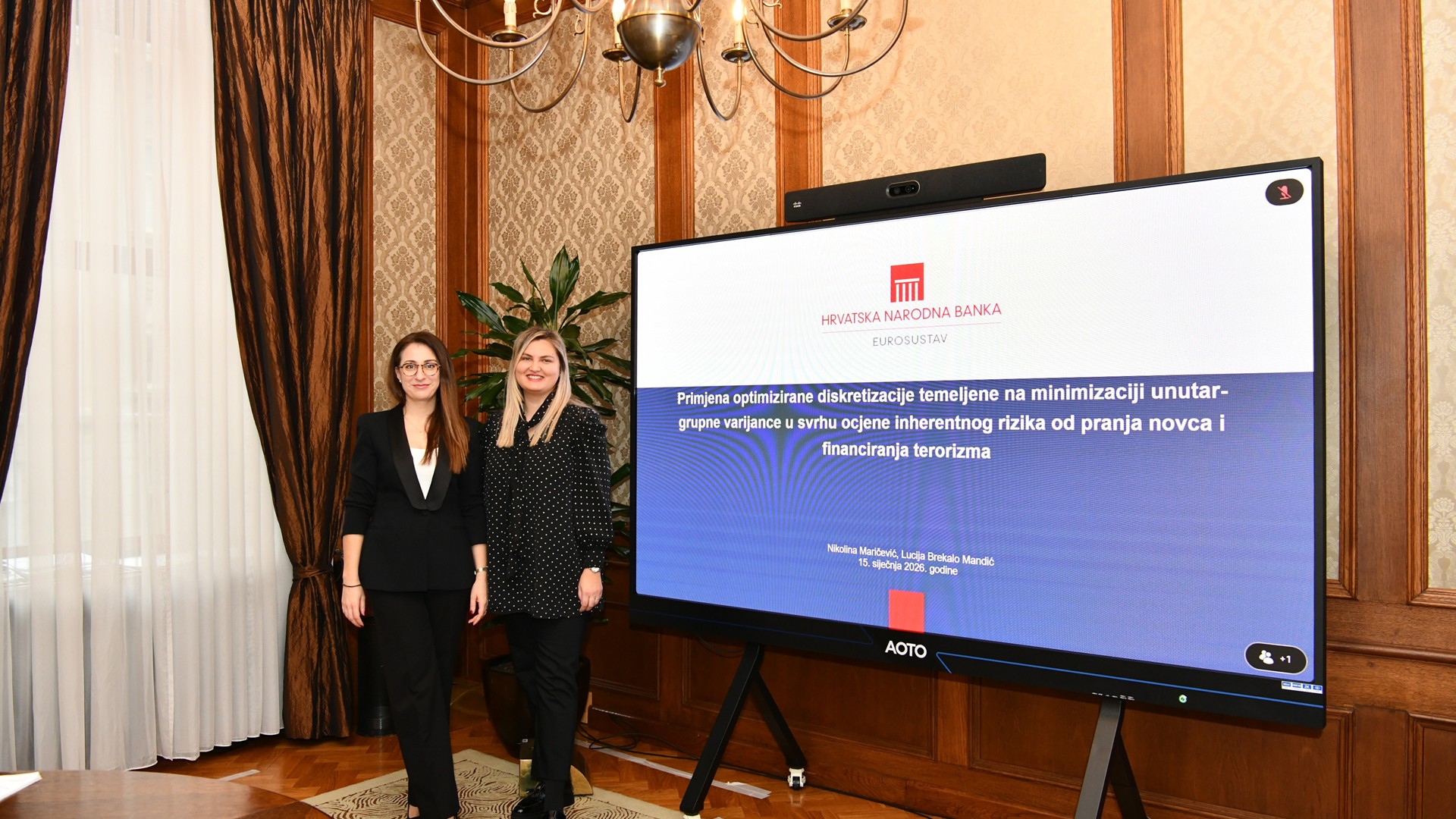
At the 76th CNB Economic Workshop held today, Nikolina Maričević, Senior Advisor, and Lucija Brekalo-Mandić, Chief Associate at the Anti-Money Laundering and Terrorist Financing Supervision Department, presented their paper "Application of optimized discretization based on minimization of intragroup variance to assess inherent risk of money laundering and terrorist financing".
The paper focuses on developing an objective and mathematically-based model for classifying quantitative indicators and risk categories, such as customer risk, product/service risk, geographical risk, and distribution channel risk, to predefined risk classes. In methodological terms, the approach is based on optimized data discretization by applying a method of intragroup variance minimization, with explicit searches across all permitted data partitions. The paper pays particular attention to the combinatorial complexity arising from the distribution of data across multiple intervals, showing that, even for a relatively small number of observations, the space of possible solutions becomes very large, which requires algorithmic processing and cannot be reliably conducted manually. It shows that the proposed methodology can be implemented in standard analytical tools and programming languages for data processing, enabling its automated, quick and replicable use in regular supervisory processes. The results suggest that the application of optimized discretization ensures statistically consistent scoring, significantly reducing subjectivity in the assessment of inherent risk, while preserving the option of supervisory judgement in duly justified cases. This approach enables a clearer differentiation between supervised entities according to risk levels and provides a more stable and transparent basis for steering supervisory activities.

"The risk assessment in the area of AML/CFT supervision relies increasingly on advanced analytics and high-quality data, but its real value derives from a combination of advanced data analysis, robust IT infrastructure and collaboration of experts with different profiles. When it meets these preconditions, risk assessment provides a sound basis for informed supervisory decision-making", concluded the authors Brekalo-Mandić and Maričević.