
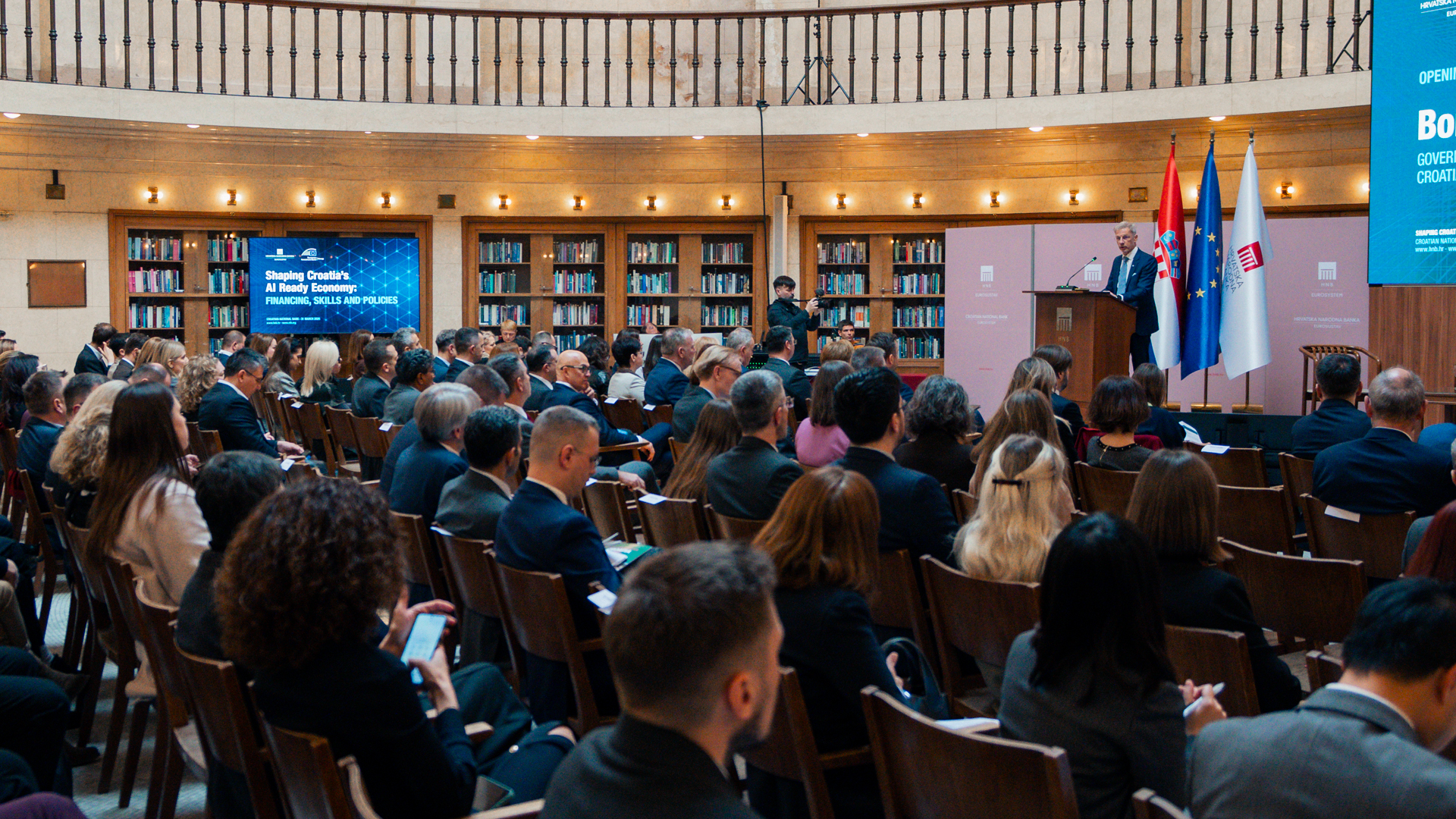
The Croatian National Bank (CNB) and the European Investment Bank (EIB) Group today hosted the conference "Shaping Croatia’s AI‑Ready Economy: Financing, Skills and Policies". Tomislav Ćorić, Deputy Prime Minister and Minister of Finance, Boris Vujčić, Governor of the Croatian National Bank, and Marko Primorac, Vice-President of the European Investment Bank delivered keynote addresses in the CNB’s Round Hall.
Primorac, in his first public appearance as Vice-President of the EIB, highlighted that accelerating AI adoption is essential for Croatia’s long-term competitiveness. “This requires sustained investment not only in technology, but also in capital markets, skills development and closer cooperation between public institutions, financial partners and industry,” said the EIB Vice-President. Boris Vujčić noted that many firms, especially smaller ones, face real challenges in adopting AI: limited access to finance, shortage of skilled workers, fragmented data, and regulatory uncertainty. “In some cases, it is also unclear what AI can actually achieve. Overcoming these barriers requires a coordinated effort, which brings me to the three key pillars highlighted at today's conference: financing, skills, and policies. Of course, as a central banker, I cannot avoid mentioning the risks such as overreliance on AI and its implications for the labour market. So, yes, we should embrace AI, but with both ambition and caution,” said the CNB Governor.

Following the keynote speeches, Debora Revoltella, Chief Economist of the EIB Group, presented the latest findings of the EIB Investment Survey 2025 for Croatia, alongside the policy conclusions of the EIB Investment Report 2025/2026, which together provide a comprehensive assessment of AI adoption among Croatian firms. The survey shows that Croatian companies continue to invest at a high rate, with 89% of firms investing, slightly above the EU average. “However, only a fifth of Croatian firms systematically use generative AI, well below the EU average, with usage remaining largely confined to internal processes. This underscores significant untapped potential for productivity growth. Croatia can build on its strong engineering skills to accelerate the uptake of artificial intelligence. This achievement will be critical to boosting productivity, moving towards higher value added activities and strengthening integration into European and global value chains, supporting sustainable job creation and long-term income growth for Croatian households,” said the EIB Group Chief Economist. She noted that according to the latest EIB Investment Report 2025/2026 the solution toolkit includes the completion of the EU`s internal market to provide business opportunities and resilience, by creating the savings and investments union to increase and simplify pan-European financing, especially for scale-up financing and advancing the transformation of the energy market and leveraging the AI potential. Finally, the report proposes developing business environment and co-investment in skills: cutting red tape to reduce firm’s costs and accelerate digitalisation, with investments in skills as key drivers of digitalisation.

The panel that followed the speeches was attended by Daniel Beck, Senior Manager, Scale-Up Funds, European Investment Fund, Maja Vitaljić, Director of the Directorate for Digital Economy at the Ministry of Justice, Public Administration and Digital Transformation, Davor Aničić, CEO and co-founder of Velebit AI and management board member of the Croatian AI Association, and Siniša Đuranović, Member of the Management Board and Chief Corporate Affairs Officer at Hrvatski Telekom.
The panel participants discussed the impact of artificial intelligence on the long-term competitiveness of the Croatian economy and its ability to provide better jobs, higher wages and more resilient and sustainable long-term economic growth. Participants pointed to the need to accelerate AI adoption by boosting the deployment of financing instruments, developing public policies, strengthening regulatory frameworks and mobilising private investment at scale. The discussion also focused on the best ways to reinforce the local innovation ecosystem and improve access to finance and skills for smaller firms. Future policy support in Croatia should prioritise the impact and mobilisation of private capital, particularly for scale-ups, to build on the effectiveness of pan-European instruments.