
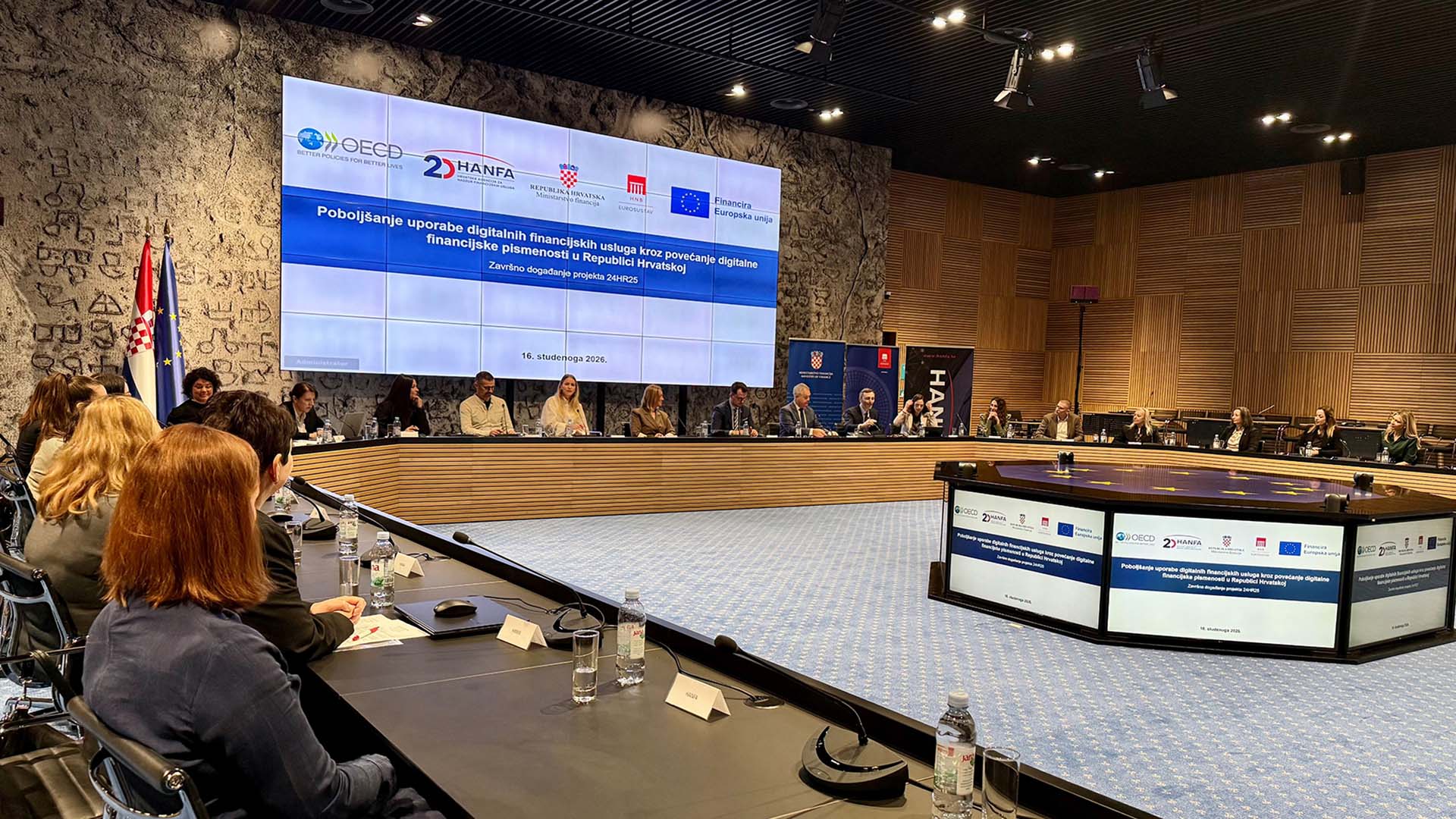
The Ministry of Finance, the Croatian National Bank (HNB) and the Croatian Financial Services Supervisory Agency (Hanfa) today presented the results of the 24HR25 project, Improving the Use of Digital Financial Services through Enhanced Digital Financial Literacy in the Republic of Croatia, at the National and University Library.
The project was funded by the European Union via the Technical Support Instrument (TSI) and implemented by the Organisation for Economic Cooperation and Development (OECD) in cooperation with the European Commission (SG REFORM) in coordination with the Ministry of Finance, HNB and HANFA.
Following welcoming remarks by financial literacy ambassadors Dajana Barbić and Toni Milun, introductory presentations were delivered by Matej Bule, State Secretary at the Ministry of Finance; Bojan Fras, Vice Governor of the HNB; and Martina Verić, Member of Hanfa’s Management Board. Representatives of all three institutions stressed that this is a valuable project that will contribute in the long term to a better understanding of digital financial products and services among Croatian citizens. The event was also attended by Andrea Grifoni and Amie Lajoie from the OECD, while Heinrich Wollny, Head of Unit at SG REFORM (European Commission), addressed the audience via video link.
The project began in 2024 and is the first project in the Republic of Croatia to be entirely dedicated to digital financial literacy. The project’s main outcome is the document Strategic Approach to Enhancing Digital Financial Literacy. Videos that will form part of a future communication campaign on digital financial literacy were also presented, along with a self-assessment tool for measuring the level of digital financial literacy and a concept for future training programmes for teachers and educators.
The need for the project stems from the increasing digitalisation of financial products and services, which, alongside numerous benefits, also exposes citizens to increasingly sophisticated fraud and other digital financial risks. The project’s findings and recommendations will be incorporated into the third National Strategic Framework for Financial Literacy for the period 2027–2032, in which digital financial literacy will constitute a separate strategic objective.
The Ministry of Finance also announced a new financial literacy web portal, which will serve as a central source of reliable and practical information on finance, financial products and services and is scheduled to be launched at the beginning of next year. In addition to a wide range of useful information, the financial literacy portal will feature a self-assessment tool for measuring the level of digital financial literacy as well as a personal budget calculator.
In the part of the programme dedicated to future activities, Hanfa presented how the project’s results can support the further strengthening of digital financial literacy and consumer protection in the non-banking financial sector. The HNB announced that it would incorporate the project’s results into its existing activities aimed at strengthening consumers’ digital financial knowledge and behaviour when using digital products and services.
The second part of the programme featured an expert discussion entitled “From Strategy to Practice: How Can We Improve Citizens’ Digital Financial Literacy?” The participants included Dajana Barbić and Toni Milun, financial literacy ambassadors in the Republic of Croatia; Petra Posedal Šimović, Professor at the Faculty of Agriculture in Zagreb; Tamara Perko, Director of the Croatian Banking Association; Vedrana Šimunić Rod, Senior Adviser at the Agency for Vocational Education and Training and Adult Education; and Danijela Princi Grgat, President of the Croatian Institute for Financial Education.
The participants discussed the practical implementation of the project’s results and the priorities of future activities aimed at improving the digital financial literacy of citizens of the Republic of Croatia. It was concluded that the growing impact of digitalisation has also contributed to an increase in fraud and scams, and that activities carried out within the framework of digital financial literacy will make a significant contribution to improving citizens’ knowledge and changing their behaviour.